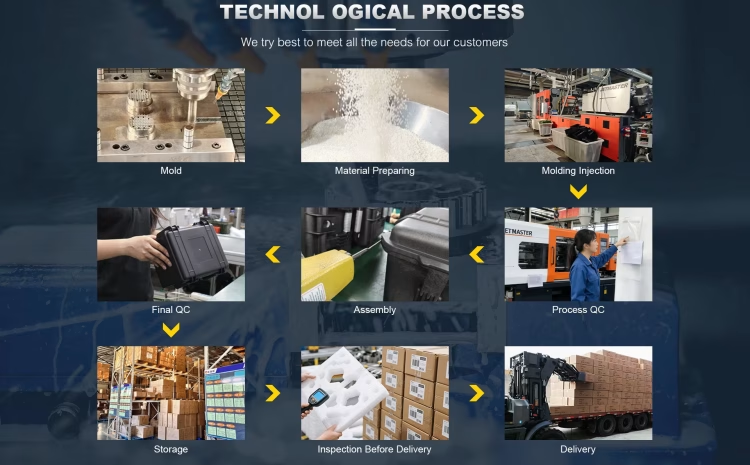
From Workshop to Everest: The Engineering Journey of a Protective Case
How can a seemingly simple plastic box promise not to crack at -40°C, not to deform under tropical sun, and still protect the精密仪器 inside after being dropped from a truck? The答案 lies in every engineering detail, from materials science to structural design. Today, let’s uncover the “hardcore” inside story of a professional protective case.
The Material Choice – Why Engineering-Grade PP Wins
Not all plastics are created equal. Ordinary plastics become brittle at low temperatures and can easily break on impact. Professional protective cases generally use engineering polypropylene (PP), a specially modified material with excellent overall performance.
- High impact resistance: Able to absorb and disperse significant impact energy instead of transferring it to the equipment it protects.
- Wide temperature tolerance: Maintains toughness across a range from -40°C to 80°C or even broader, without wrinkling or cracking.
- Chemical corrosion resistance: Resists erosion from common chemicals such as oils, acid rain, and salt spray.
- Lightweight: Provides strong protection while minimizing carrying burden to the greatest extent.
Structural Intelligence – The Strength Hidden in the Shell
A sturdy box is not made of thick plastic, but a carefully calculated system of force distribution.
- Reinforcement Rib Network: The inner walls of the case are not flat but are covered with a network of intersecting reinforcement ribs. Similar to beams in construction, this greatly enhances overall rigidity and resistance to bending and deformation using minimal material.
- Impact-Resistant Corner Protection: The most vulnerable corners of the case are thickened and designed with rounded edges or rubber coverings, serving as the first line of defense against the most common dropping scenarios.
- Stress-Distribution Design: The connections between the latches, hinges, and the case are specially reinforced to ensure durability after tens of thousands of openings and closings, and to evenly distribute locking force across the entire case seal.
The Art of Sealing – Absolute Defense Within a Millimeter
The core of waterproofing and dustproofing lies in the sealing system, which is the part that requires the highest precision.
- Composite Sealing Strip: High-quality silicone sealing strips are precisely embedded in the grooves of the case. When the latch is fastened, they undergo uniform compression deformation, forming a physical barrier.
- Air Pressure Balance Valve: A clever little device. It allows air to slowly pass through to balance the pressure difference caused by changes in altitude (preventing the case from being difficult to open), but it blocks water molecules, making it a key feature that balances sealing and practicality.
Every design choice, every test, serves one simple goal: when accidents happen, let our case take the hit, so your equipment remains safe and sound. This is the engineering promise carried by a professional protective case, from the workshop to the top of the world.